
Class 6 Worksheet on Reflexive vs Emphatic Pronouns

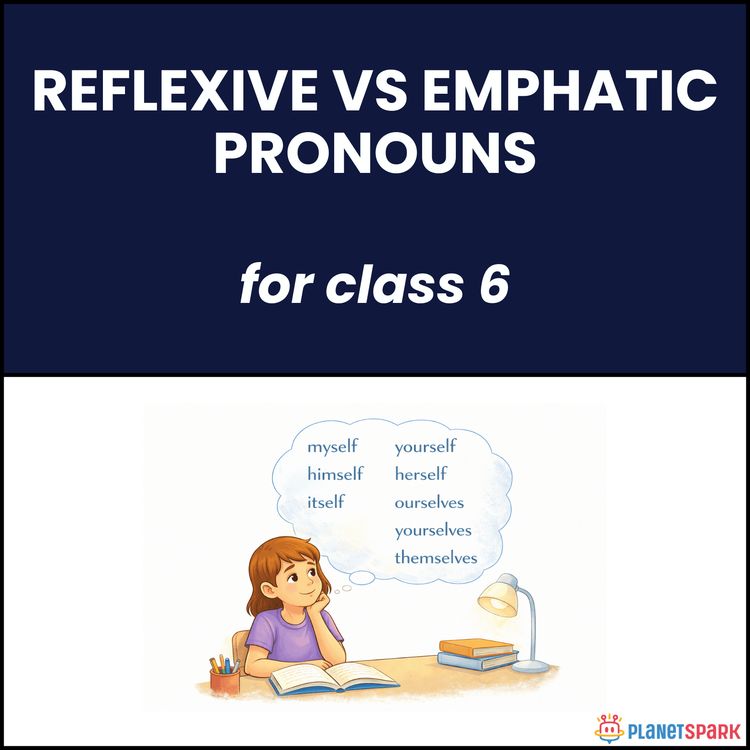
Class 6 Worksheet on Reflexive vs Emphatic Pronouns
Self or Emphasis: Mastering Reflexive and Emphatic Pronouns for Grade 6
This Grade 6 worksheet helps students clearly understand the difference between reflexive pronouns (myself, yourself, himself, herself, ourselves, themselves) and emphatic pronouns. Through engaging and structured exercises, learners practise when to use pronouns for self-action and when to use them for emphasis.
With a mix of true/false, multiple choice questions, fill in the blanks, error correction, and paragraph-based activities, this worksheet strengthens students’ ability to use pronouns accurately in different contexts.
Why Reflexive vs Emphatic Pronouns Matter in Grammar?
Understanding reflexive and emphatic pronouns is essential for Grade 6 learners because:
1. It helps students express actions done by the subject clearly.
2. It adds emphasis to sentences effectively.
3. It prevents common grammatical errors.
4. It improves sentence clarity and communication skills.
What’s Inside This Worksheet?
This worksheet includes five structured activities to build strong grammar skills:
🧠 Exercise 1 – True or False
Students identify whether reflexive and emphatic pronouns are used correctly.
✔️ Exercise 2 – Multiple Choice Questions
Students choose the correct sentence with proper pronoun usage.
✏️ Exercise 3 – Fill in the Blanks
Students select the correct reflexive or emphatic pronoun from given options.
📋 Exercise 4 – Underline and Rewrite
Students correct incorrect pronouns and rewrite sentences properly.
📝 Exercise 5 – Paragraph Writing
Students complete a paragraph using suitable reflexive and emphatic pronouns in context.
This worksheet helps learners apply grammar concepts in practical situations, improving both accuracy and confidence.
✅ Answer Key (For Parents & Educators)
Exercise 1 – True or False
1. True 2. False 3. True 4. False 5. True
6. False 7. True 8. False 9. True 10. False
Exercise 2 – Multiple Choice
1. a 2. b 3. b 4. a 5. b
6. a 7. b 8. a 9. b 10. a
Exercise 3 – Fill in the Blanks
1. himself 2. herself 3. ourselves 4. themselves 5. myself
6. himself 7. herself 8. themselves 9. himself 10. ourselves
Exercise 4 – Rewritten Sentences
1. The scientist himself explained the concept clearly.
2. She completed the entire task herself without help.
3. We ourselves arranged the exhibition successfully.
4. The players blamed themselves for the defeat.
5. He completed the project by himself.
6. They congratulated themselves after winning the match.
7. I prepared myself well before the final round.
8. The leader himself addressed the team confidently.
9. She looked at herself before going on stage.
10. We enjoyed ourselves during the camp activities.
Exercise 5 – Paragraph Writing
During a robotics workshop, Ishan and Tara were asked to design a simple machine. They themselves decided to work without taking help from others. Ishan prepared himself carefully before starting the task. Tara, on the other hand, tested the machine herself to check if it worked properly.
The mentor himself observed their progress and guided them when needed. Some participants encouraged themselves to try new ideas. Ishan looked at himself in a reflective screen and corrected his mistakes. Tara pushed herself to improve her design further.
In the final round, both students presented their project confidently and handled the questions themselves. The mentor appreciated their effort and said they had managed the task themselves. Ishan and Tara felt proud of themselves for completing the challenge successfully.
Help your child build strong grammar confidence and use pronouns correctly in every sentence they speak or write.
Frequently Asked Questions
Reflexive pronouns (myself, yourself) refer back to the subject, while emphatic pronouns emphasize the subject.
Use sentences where reflexive pronouns show action to oneself, and emphatic pronouns add emphasis to the subject.
Include sentences where students decide whether the pronoun is emphasizing or reflecting the action.